2026 Mac mini: Price, M6 vs. M5 Pro & How It Runs AI Agents
Update log (1)
- — Re-checked 2 September 2026 against Apple's store and tech-specs pages: prices, memory bandwidth figures and the 22 September ship date all unchanged, and still no independent benchmark. Added the Thunderbolt distinction — clustering over Thunderbolt 5 at 120Gb/s is an M5 Pro feature, the M6 has Thunderbolt 4 at 40Gb/s — and noted the third-party pre-order discounts that appeared after publication.
The 2026 Mac mini ships on 22 September 2026, per Apple’s own store. From that date real benchmarks exist and the AI section here — which rests on Apple’s figures and on arithmetic, because nobody has run one yet — needs re-reading against them.
Everything else on the page is unaffected; the figures below still say when they were read.

- The M6 starts at $899 and the M5 Pro at $1,699, both announced 25 August 2026 and shipping 22 September. Memory costs $25 a gigabyte on either chip — but the M6 stops at 32GB, so 48GB costs $1,000 more than 32GB rather than $400.
- Every AI benchmark Apple published measures time to first token — the reading half. For token generation, the writing half, Apple says M5 Pro is faster and publishes no number at all.
- That gap matters because generation speed tracks memory bandwidth, and there the older Pro chip wins: 307GB/s against 153GB/s on a base M6, or 170GB/s once you upgrade its memory.
- For agents the practical rule is that memory decides what you can run and bandwidth decides how fast it answers. A $1,299 32GB M6 is the value pick; $2,699 buys 64GB and twice the bandwidth.
Apple announced the 2026 Mac mini on 25 August, with two chips and a striking split in what it chose to measure. The M6 gets the headline: first-ever dual Neural Engine, up to 4.8× the M4. The M5 Pro, an older-generation Pro part, quietly keeps twice the memory bandwidth.
If you are buying this to run AI agents, that second fact is the one that decides your purchase, and it is not the one on the poster.
How much does the 2026 Mac mini cost?
From $899 for the M6 and $1,699 for the M5 Pro, with orders open now and shipping on 22 September. Those are the entry prices; what you will actually spend depends almost entirely on memory.
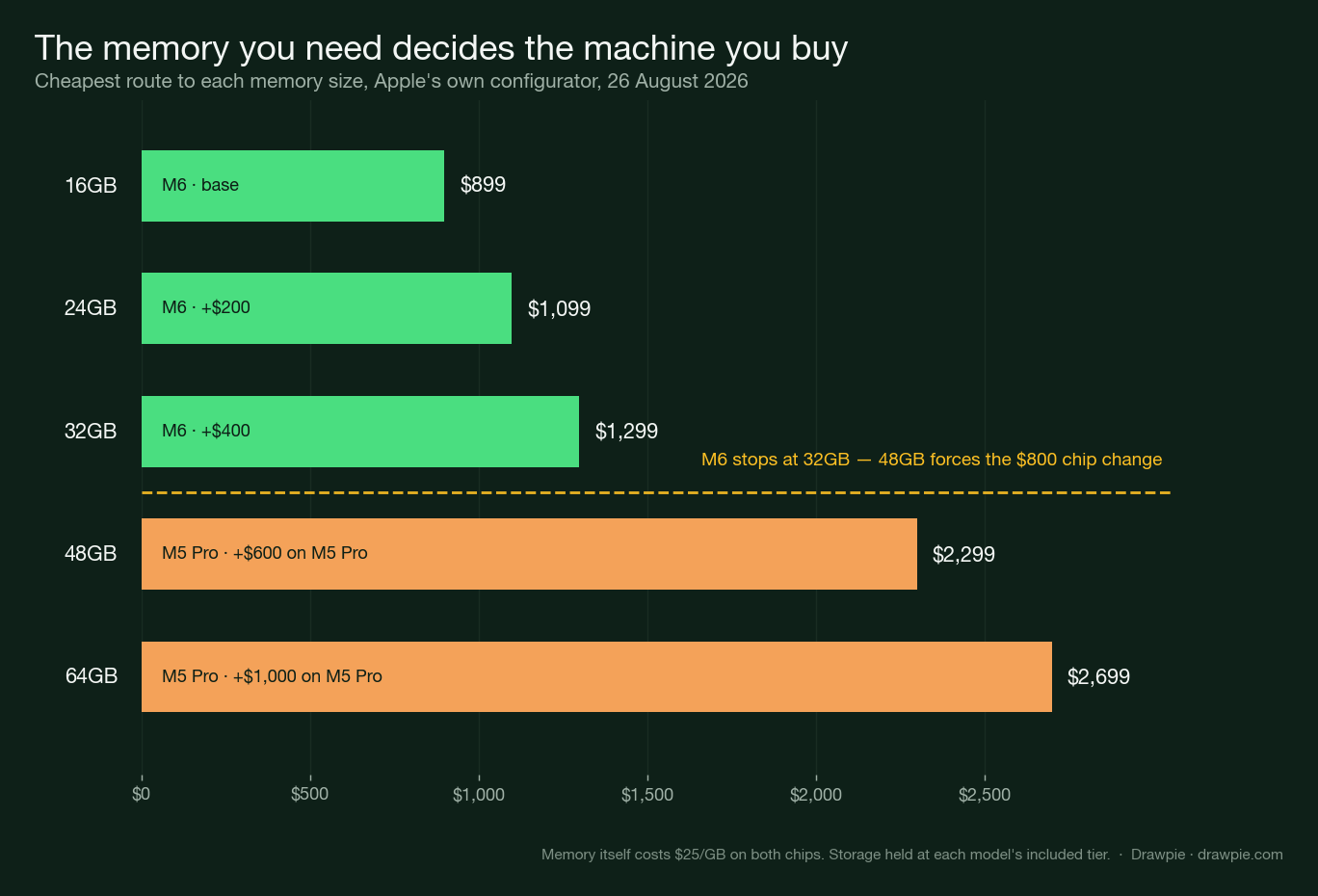
Apple charges a flat $25 a gigabyte on both chips — $200 for 8GB, $600 for 24GB, $1,000 for 40GB. The memory itself is priced consistently. What is not consistent is where it stops.
| Upgrade | M6 | M5 Pro |
|---|---|---|
| Base price | $899 | $1,699 |
| Memory included | 16GB | 24GB |
| Maximum memory | 32GB (+$400) | 64GB (+$1,000) |
| Storage included | 256GB | 512GB |
| Faster CPU/GPU | — | +$200 |
The M6 tops out at 32GB. Go to 48GB and Apple changes the chip on you, which is why the step from 32GB to 48GB costs $1,000 rather than the $400 the per-gigabyte rate implies. Storage follows its own ladder: on the M6, 512GB is +$200, 1TB +$500, 2TB +$1,000. Ten-gigabit Ethernet is +$100 on either. Those are Apple’s prices; since pre-orders opened, third-party sellers have started shading them — as of 1 September Amazon listed the base M6 at $880, the 16GB/512GB at $1,070 and the base M5 Pro at $1,669, all for the same 22 September delivery. The discounts are small and they move, but the sticker is no longer the only price.
M6 vs M5 Pro: what actually differs?
Cores and clocks on one side, memory and bandwidth on the other. The M6 is the newer design; the M5 Pro is the bigger one.
| M6 | M5 Pro | |
|---|---|---|
| CPU | 12-core | 15- or 18-core |
| GPU | 12-core | 16- or 20-core |
| Neural Engine | Dual 16-core | 16-core |
| Max memory | 32GB | 64GB |
| Memory bandwidth | 153–170GB/s | 307GB/s |
| Thunderbolt | 3× Thunderbolt 4 (40Gb/s) | 3× Thunderbolt 5 (120Gb/s) |
The dual Neural Engine is genuinely new — Apple calls it a first — and the M6 also brings super cores in the CPU and Neural Accelerators in each GPU core. On Apple’s own numbers it is up to 4.8× an M4, against 4× for the M5 Pro over an M4 Pro.
But look at the bottom row. The M5 Pro moves data between memory and the chip at roughly twice the rate, and that is the number that decides how a local model behaves once it starts writing.
How well does it run AI agents?
Well — and Apple has published half the evidence. Every AI benchmark on Apple’s Mac mini page measures the same thing: time to first token.
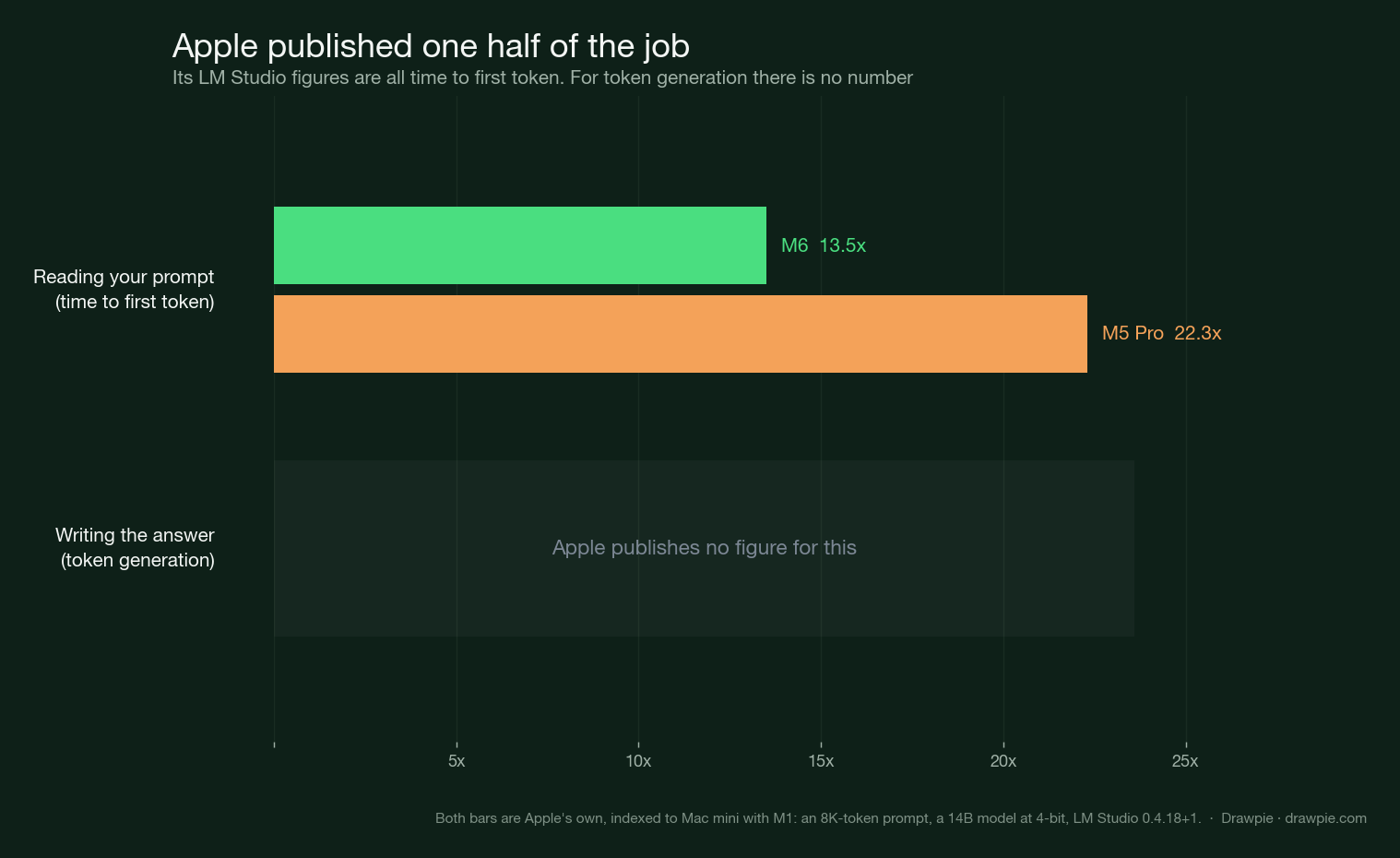
Running a model is two jobs. Reading your prompt — prefill, which ends at the first token — is compute-heavy, and that is where the new Neural Engine and GPU accelerators earn their keep. Writing the answer — generation — reads the entire model out of memory for every single token produced, which makes it a bandwidth problem rather than a compute one.
Apple published numbers for the first job and prose for the second. Its M5 Pro section says more unified memory means “faster AI token generation” and attaches no figure. Its M6 section, describing the same class of work, points at “creating AI agents that automate daily tasks” without a generation number either.
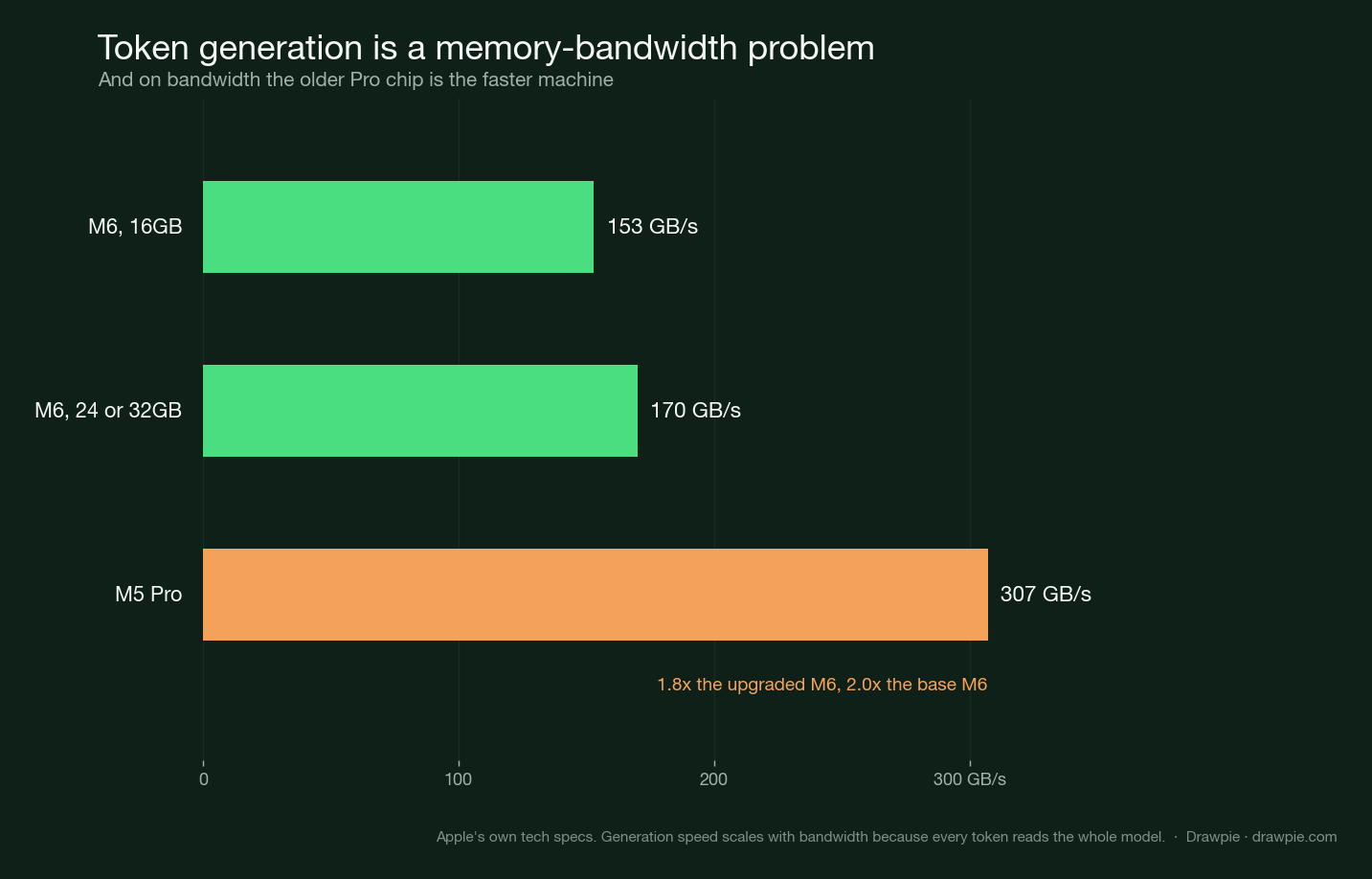
You can see why. On Apple’s own specs the M5 Pro has 1.8× the bandwidth of a memory-upgraded M6 and 2.0× that of the base machine — and since generation speed scales with bandwidth, that ratio is roughly the ceiling on how much faster it will write. That is arithmetic from published specs, not a benchmark; nobody has run one, because these ship on 22 September.
For agents specifically, the shape of the work makes both halves matter. An agent loop reads a long context on every step, which is prefill, and then writes tool calls and reasoning, which is generation. The M6 is better at the first. The M5 Pro is better at the second, and has room for models the M6 cannot load at all.
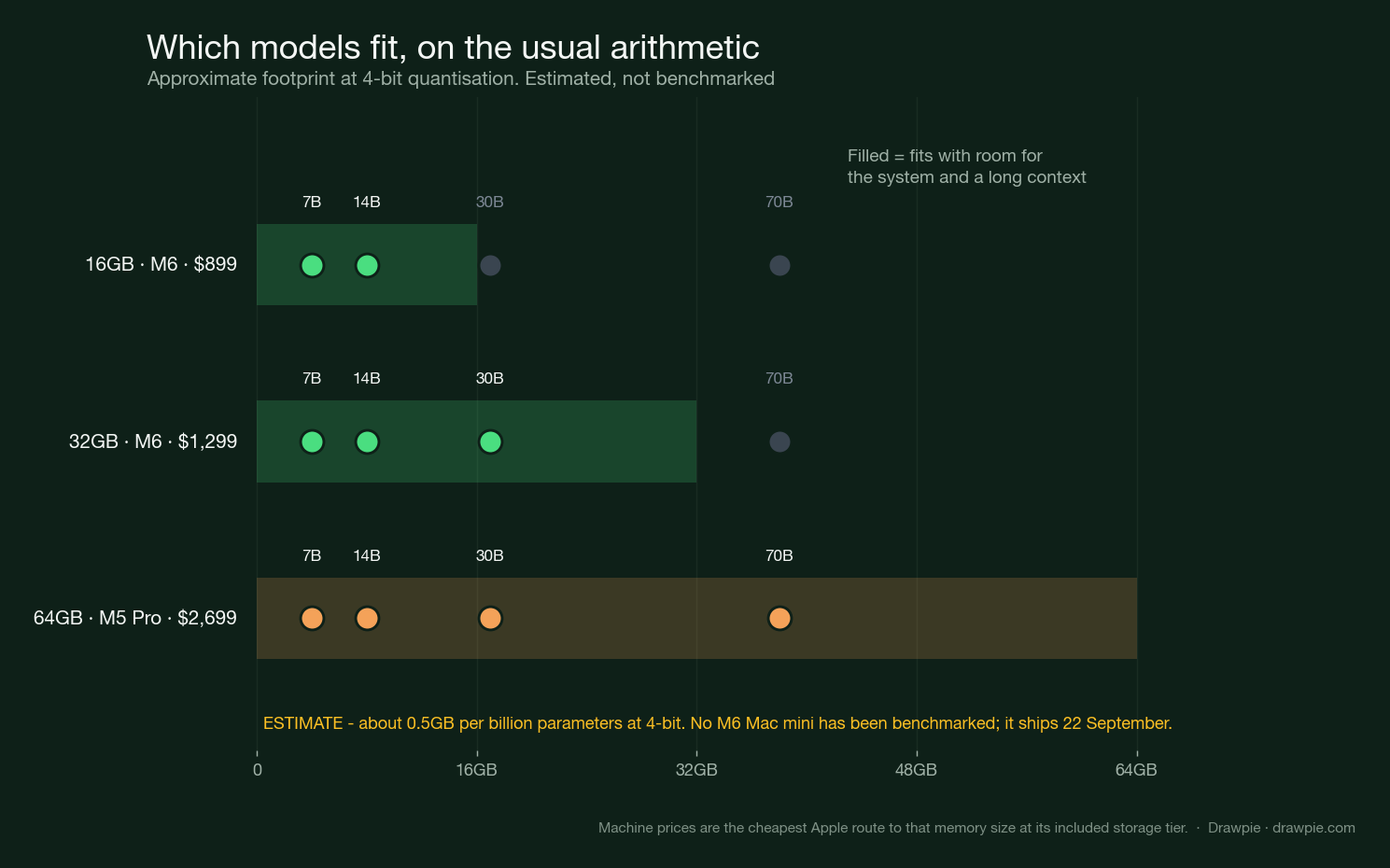
That last constraint is the hard one. Memory decides what you can run; everything else decides how pleasant it is. Apple’s own configurator makes the point for us — the description attached to the M5 Pro’s CPU upgrade names “running large language models” as a reason to pay for it.
Worth knowing if you were considering two boxes instead of one: Apple explicitly describes clustering Mac minis over Thunderbolt 5 at 120Gb/s “to run larger local AI models”, and names exo and LM Studio Bionic as the software for it. Check the port before you plan on it, though: Thunderbolt 5 is an M5 Pro feature. The M6 has three Thunderbolt 4 ports at 40Gb/s, so two cheap M6 boxes cluster over a link a third the speed of the one Apple is describing.
Which one should you buy?
The $1,299 M6 with 32GB, unless you already know you need a bigger model. That is the configuration where the M6’s price advantage and its memory ceiling meet.
- $899, M6, 16GB — fine for agents driving cloud models, and for small local ones. Tight for anything past about 14 billion parameters once you allow for a long context.
- $1,299, M6, 32GB — the value pick. Comfortable for models in the 30B class, and it costs $1,000 less than the cheapest 48GB machine.
- $2,299–$2,699, M5 Pro, 48–64GB — the only way to run 70B-class models locally, and the only way to get 307GB/s. Buy it for the memory, and treat the bandwidth as the bonus that makes it feel quick.
One thing not to buy it for: the Neural Engine headline. The dual 16-core engine is real and the prefill numbers are genuinely large, but if your agent spends its time writing rather than reading, the part of the machine you will feel is the memory bus — and on that measure the cheaper-looking upgrade path is the one that stops at 32GB.
Everything here comes from Apple’s own store and specifications, read on 26 August 2026 and re-checked on 2 September, when Apple’s prices, specifications and 22 September date were all unchanged. The independent benchmarks that would settle the generation question still do not exist — no M6 Mac mini result has appeared anywhere outside Apple — and will not until these ship on 22 September.
How we verified this
Every price here was read from Apple’s own configurator on 26 August 2026, not from the launch coverage. The base prices come from the buy page and each upgrade from the option rows on the configuration pages. That matters because coverage on the day quoted “$899 and $1,699”, which is true and describes two of the many configurations you can actually order. Reading the option rows is what produced the $25-a-gigabyte figure and the $800 chip step.
Specifications are Apple’s tech-specs page. The 153GB/s, 170GB/s and 307GB/s bandwidth figures, the core counts, and the maximum memory for each chip are all Apple’s own published numbers.
🔴 The two Apple benchmark multipliers were checked for a shared baseline before being compared. It would be easy to set 22.3x against 13.5x and assume they are commensurable. They are: Apple’s M6 chart reads M6 13.5x, M4 2.8x, Mac mini with M1, and its M5 Pro chart reads M5 Pro 22.3x, M4 Pro 5.6x, M2 Pro 2.6x, Mac mini with M1. Same baseline machine, so the ratio between them is meaningful. We looked rather than assumed, and the answer happened to be yes.
⚠️ Apple’s test configurations are not identical to each other. Its footnotes say the M6 and M4 machines both had 32GB and a 2TB SSD, the M4 Pro machine had 64GB and 8TB, the M2 Pro machine 32GB and 8TB, and the M1 machine 16GB and 2TB. For a prompt-processing test with a model that fits in all of them this should not dominate, but it is not a like-for-like bench and we are not presenting it as one.
✅ Apple’s own test, quoted exactly: “Time to first token measured with an 8K-token prompt using a 14-billion parameter model with 4-bit quantization, and LM Studio 0.4.18+1.” Testing was conducted by Apple in July 2026 on preproduction M6 systems.
🔴 The model-fit chart is arithmetic, not measurement, and says so on its face. It uses the standard approximation of roughly 0.5GB per billion parameters at 4-bit, plus working room for the system and context. No M6 Mac mini has been benchmarked by anyone outside Apple, because it does not ship until 22 September. Treat those rows as a sizing guide, not a result.
We did not benchmark anything. Nobody has one. Everything on this page is Apple’s published figures, Apple’s published prices, and arithmetic that is labelled as arithmetic wherever it appears.